



Dubai has become one of the world’s most sought-after destinations for professionals, families, and digital nomads looking to build a better life under the sun. With zero income tax, world-class infrastructure, and a genuinely international community, the UAE has transformed from a regional business hub into a global lifestyle destination that attracts talent from every corner of the planet. But moving to Dubai is a process, and the experience of thousands of expats who’ve made the move reveals a consistent pattern: the ones who arrived prepared had a dramatically smoother transition than those who figured things out on the fly.
This guide covers the essentials that first-time movers to Dubai consistently say they wish someone had explained before they landed.
1. Understand Your Visa Situation Before You Arrive
This is the single most common source of stress for new arrivals, and it’s entirely avoidable with a little advance planning.
The UAE operates on a residence visa system; you can’t simply land and start working. Your employer will typically sponsor your employment visa, but the timing matters enormously. Between your job offer and your visa being fully processed and stamped, there’s a window where your status in the country is technically on a tourist or visit visa.
During this period, you can’t rent a long-term apartment (landlords require a valid Emirates ID), open a UAE bank account, or access various services tied to residency.
What most people don’t realize is just how many different visa categories exist — employment visas, freelance permits, investor visas, Golden Visas, spouse and dependent visas, and more. Each has different requirements, processing times, and implications for what you can and can’t do in the UAE.
If you’re coming with a family, the visa situation becomes considerably more complex. Sponsoring your spouse and children requires separate applications, specific income thresholds, and proper documentation of your relationship. Processing can take weeks if documents aren’t in order from the start.
Getting proper guidance from a UAE-licensed visa and government services provider makes a real difference here. One resource expats in Dubai commonly recommend is oki-doki.ae — the team there handles the full range of UAE residency and visa services, from employment visa processing to Golden Visa applications and family sponsorships.
2. The Cost of Living Is Higher Than Most Expect — and Lower in Some Areas
Dubai’s cost of living surprises most new arrivals in both directions.
More expensive than expected:
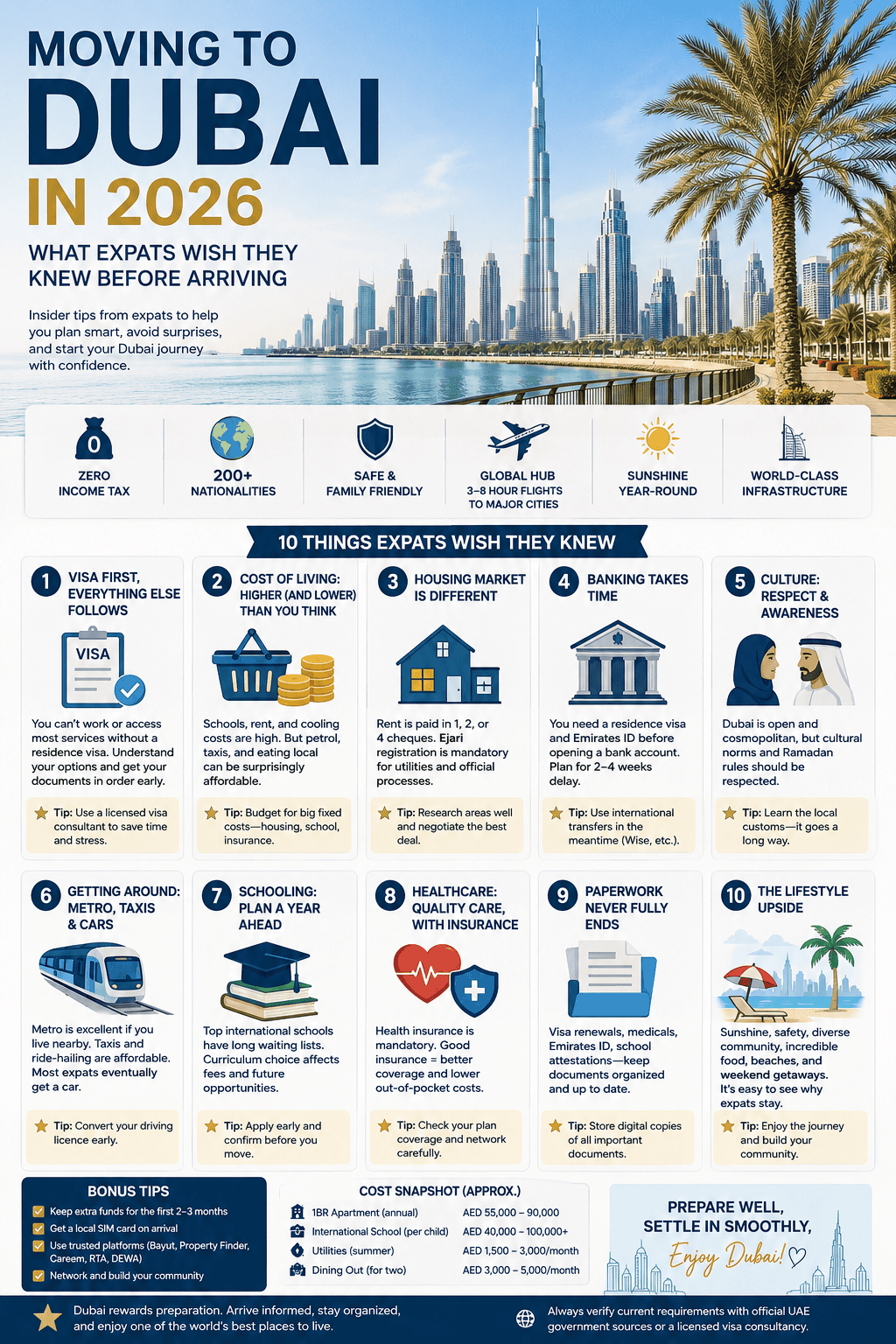
- School fees for international schools are eye-watering — AED 40,000–100,000+ per year per child for good international curriculum schools
- Dining out regularly adds up fast; eating at nice restaurants 3–4 times a week comfortably costs AED 3,000–5,000/month for a couple
- Cooling costs (electricity + district cooling) in summer can run AED 1,500–3,000/month for an apartment
- Healthcare — there’s no NHS equivalent; private health insurance is mandatory and can be expensive for families
Cheaper than expected:
- Petrol is significantly cheaper than Europe — filling a tank cost roughly AED 90–130
- Taxis and ridesharing are affordable by global standards
- Eating at local restaurants, shawarma spots, and food courts is genuinely cheap — a full meal for AED 20–35
- Many entertainment options (beaches, parks, community events) are free or low-cost
The key to budgeting well in Dubai is understanding which expenses are unavoidable fixed costs (housing, school, insurance) and where there’s genuine flexibility.
3. Finding Housing: Know the Market Before You Sign
Dubai’s rental market operates differently from most Western countries, and the differences matter.
Cheques, not monthly payments. Landlords in Dubai typically ask for rent paid in 1, 2, or 4 cheques per year — not monthly. This means having a lump sum ready upfront. If you’re arriving with savings, this is manageable. If you’re expecting to pay monthly like a UK or European rental, you’ll be in for a surprise.
Ejari registration. Every rental contract must be registered with Ejari (Dubai Land Department’s online system). This is non-negotiable — without Ejari, you can’t get utilities connected (DEWA), and the registration number is required for Emirates ID address changes, visa applications, and various government services.
The difference between listed and actual prices. Prices listed on property portals (Bayut, Property Finder) often reflect asking prices, not necessarily what’s being achieved. In many areas, actual market rent is negotiable, especially for longer contracts or if you can offer fewer cheques.
Area matters enormously. Dubai Marina and Downtown Dubai carry a significant premium for the lifestyle access. Jumeirah Village Circle (JVC), Al Barsha, and Mirdif offer far better value with manageable commutes. If your children are in schools in specific areas, building your housing search around the school location first saves a lot of daily friction.
4. Banking Takes Longer Than You’d Think
Opening a UAE bank account typically requires:
- Valid UAE residence visa (not just an entry stamp)
- Emirates ID (which requires the residence visa to be stamped)
- Salary certificate or letter of employment from your employer
In practice, this means there’s a 2–4 week minimum before you can open a local bank account, even if everything goes smoothly. During this time, international transfers via Wise or your home country account become essential.
Once you have an account, UAE banking is generally efficient. Emirates NBD, Abu Dhabi Commercial Bank (ADCB), Mashreq, and FAB are the main options for expats. Most offer good mobile banking apps, and international transfers are straightforward once set up.
5. The Culture: More Relaxed Than Most Expect, with Clear Lines
Dubai is, by Gulf standards, a very open and cosmopolitan city. Alcohol is available in licensed venues. Western clothing is normal in shopping malls, restaurants, and most public spaces. Men and women work together in offices across every sector.
That said, there are clear cultural norms that expats should understand and respect:
Public displays of affection beyond handholding are frowned upon, particularly during Ramadan. Unmarried couples living together exists throughout Dubai but is technically prohibited — in practice, landlords rarely ask and the law is rarely enforced, but it’s worth knowing.
Ramadan transforms the city. During daylight hours, eating, drinking, and smoking in public are prohibited. Alcohol service hours change. Business hours shift. The atmosphere in the city changes noticeably — quieter during the day, more vibrant after Iftar. For expats, Ramadan is generally a positive experience once you understand the rhythms.
Dress codes at beaches, pools, and brunch venues are Western-normal. In traditional souks, mosques, and government buildings, more conservative dress is expected.
Dubai rewards those who engage with the culture rather than staying exclusively within the expat bubble.
6. Getting Around: The Metro Is Underused, Taxis Are Everywhere
Dubai Metro is excellent — clean, air-conditioned, reliable, and cheap. The Red and Green Lines cover the main business and residential corridors. If you live and work near a Metro station, you can genuinely live without a car. The issue is that many residential areas (particularly villas and older developments) aren’t well-connected to the Metro network.
Ride-sharing (Careem, Uber, in Drive) is widely used and affordable. For regular commutes though, the cost adds up — AED 30–60 per trip each way means AED 3,000–6,000/month if you’re commuting daily.
Driving. Most long-term expats end up buying or leasing a car. UAE driving licences are relatively easy to obtain for holders of UK, US, EU, and most other Western licenses — typically a straightforward process of converting your existing licence rather than retaking a test. For other nationalities, the process involves actual driving lessons and tests, which takes several months.
Petrol is cheap, but Salik (toll) charges and parking in central areas can add meaningful costs.
7. Schooling: Plan a Year Ahead
If you’re moving with school-age children, school admissions is the most time-sensitive item on your pre-move list.
Dubai’s top international schools — GEMS Wellington, Jumeirah English Speaking School (JESS), Dubai British School, and others — often have waiting lists of 1–2 years for popular year groups. Even mid-tier schools fill up quickly in September.
The curriculum to choose depends partly on your family’s plans. British curriculum schools are the most common and offer the widest choice. American curriculum schools exist but are fewer. IB schools offer international recognition useful for families who might move again.
School fees are paid termly or annually, and many require a deposit and registration fee before your visa is even processed.
8. Healthcare: Good Quality, but You Must Have Insurance
UAE law requires employers to provide health insurance for employees (and in Abu Dhabi, for dependents too). The quality of the insurance matters a lot — basic insurance has significant co-pays, low annual limits, and restricted networks. Good insurance covers most major private hospitals.
Private hospitals in Dubai are genuinely good — Mediclinic, American Hospital Dubai, King’s College Hospital Dubai, and Cleveland Clinic Abu Dhabi offer international-standard care. The UAE has also invested significantly in specialist facilities over the past decade.
For non-emergency care, GP clinics are widely available and generally efficient. Waiting times are much shorter than in most NHS-equivalent systems.
9. Visa Renewals and the Paperwork Reality
Living in Dubai is wonderful, but the paperwork never fully goes away. Employment visas are typically valid for 2–3 years and require renewal. Each renewal involves a medical test, biometrics, and updated documentation. If you change employers, your visa situation resets and new paperwork begins.
One practical tip from experienced expats: keep digital copies of every document — passport, visa, Emirates ID, Ejari, medical certificates, educational attestations — in a secure cloud storage. Government processes in the UAE often require these documents on short notice and having them organized saves considerable stress.
For families, the paperwork complexity multiplies. Spouse and dependent visas, school attestations, NOC letters from employers — it’s a significant administrative overhead that is best managed systematically.
UAE-based visa and government services consultancies like oki-doki.ae handle the full cycle of this ongoing paperwork for expats who’d rather spend their time actually living in Dubai than navigating government portals.
10. The Lifestyle Upside: Why People Stay
For all the paperwork and upfront complexity, the reason Dubai’s expat community keeps growing is simple: the quality of life is genuinely exceptional once you’re settled.
Year-round sunshine (albeit extreme heat from June–September, where outdoor activity between 11am and 5pm is essentially off the table). World-class restaurants from every culinary tradition. Beaches and desert landscape within an hour of each other. Safe streets — Dubai consistently ranks among the safest cities in the world. A genuinely diverse, interesting social scene built from 200+ nationalities living alongside each other.
Weekend trips to the Maldives, Sri Lanka, Bali, or East Africa are 3–5-hour flights and often affordable with UAE-based airlines. For UK and European expats, flights home is typically 6–8 hours — close enough to maintain real relationships without the distance feeling overwhelming.
The common trajectory for Dubai expats is to arrive planning to stay two or three years and find themselves still there a decade later.
Final Thoughts: The Prep Makes the Difference
Moving to Dubai rewards preparation. The expats who settle in quickly are invariably those who sorted their visa paperwork in advance, understood the rental market before signing, had their banking and insurance sorted early, and knew what school their children were enrolling in before the family arrived.
The ones who found the first six months difficult are usually those who underestimated the administrative complexity — particularly around the visa process — and spent their first weeks in a holding pattern, waiting for documents to clear while paying for short-term accommodation.
Dubai is one of the most genuinely exciting cities in the world to live in. Arriving with the right information makes it much easier to start enjoying it from day one.
This guide reflects general expat experiences in Dubai as of 2026. Individual circumstances, nationality, and employer situation can significantly affect visa processes and timelines. Always verify current requirements with official UAE government sources or a licensed UAE visa consultancy.