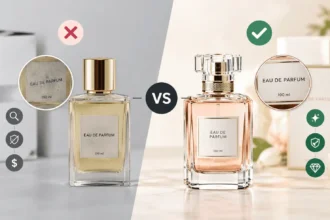



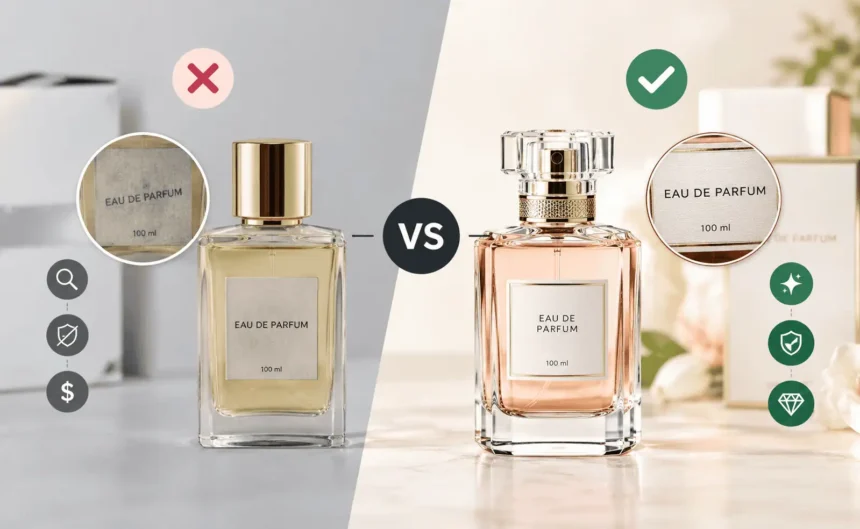
Buying a designer perfume should feel exciting, not like a gamble. However, counterfeit fragrances can look surprisingly convincing, from the outer box to the bottle and label. A low price may raise suspicion, but even an expensive perfume can be counterfeit.
So, how can you identify fake perfume vs. authentic perfume before spending your money?
The best approach is to assess several clues together. Check the seller, compare the packaging with official product images, inspect the bottle, examine the batch code, and pay attention to how the fragrance smells. No single check can confirm authenticity in every case, but combining these steps can help you make a more informed decision.
This guide explains what to look for before buying perfume online or in person, what common authenticity myths to avoid, and where to buy authentic perfume online in Canada and the United States.
How to Identify Fake Perfume vs. Authentic Perfume: 10 Ways to Check
An authentic perfume is a genuine product made by the brand or through its legitimate manufacturing arrangements. A counterfeit perfume imitates a branded product and misrepresents its origin.
A fragrance that smells similar to a designer perfume is not automatically counterfeit. Legitimate alternative fragrances and inspired-by scents exist, provided they are marketed honestly and comply with applicable laws. The key distinction is whether a seller falsely presents an imitation as the original branded product.
Counterfeit fragrances also raise safety concerns because their ingredients and manufacturing conditions may be unknown. Counterfeit cosmetics may contain unsafe ingredients, toxic substances, or harmful bacteria that can pose risks to your skin and health. Check product packaging, ingredient lists, seller credibility, and official safety guidance before purchasing cosmetics.
10 Ways to Identify Fake Perfume vs. Authentic Perfume
1. Research the Seller Before Buying
The seller’s reputation is one of the most useful clues because you can assess it before the perfume arrives.
Start with the brand’s official website. Check whether it lists the retailer as an authorized seller. If the retailer does not appear on the list, contact the brand to ask whether it can confirm the seller’s status.
If you are considering an independent fragrance retailer, investigate its business details, customer service, product descriptions, and authenticity policy.
Look for:
- A verifiable business identity and working contact information.
- Clear shipping, refund, and return policies.
- Recent customer reviews across independent platforms.
- Specific product descriptions rather than vague claims.
- A clear process for resolving authenticity concerns.
A professional-looking website is not proof of authenticity. Counterfeit sellers can create polished storefronts, too. Consider the seller’s overall credibility rather than relying on website design alone.
2. Compare the Packaging With Official Images
Packaging can reveal inconsistencies that are difficult to explain.
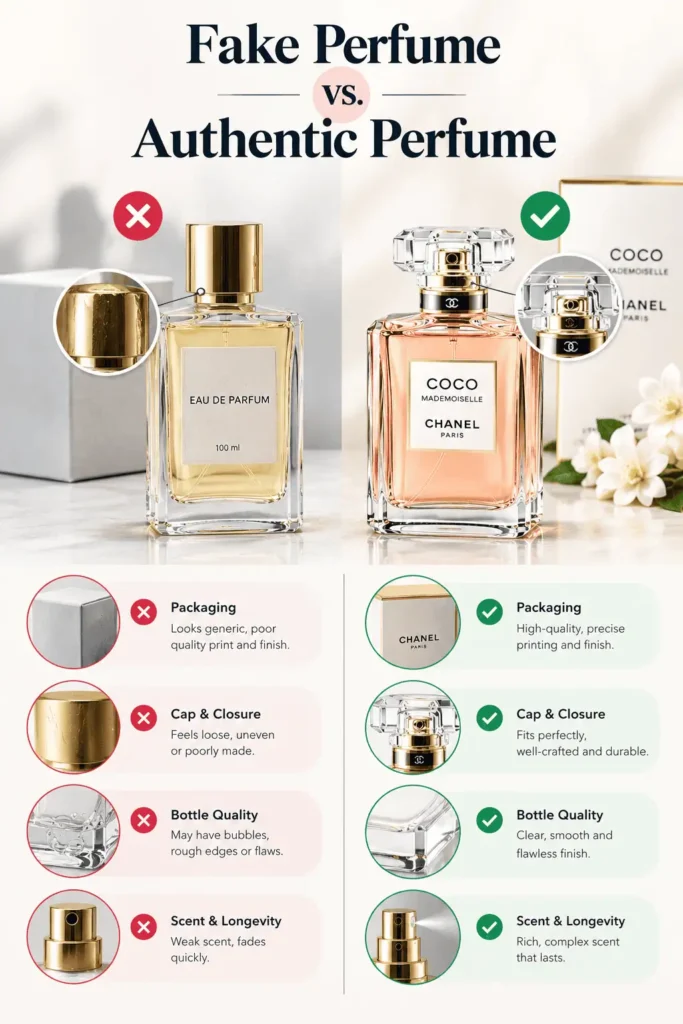
Before purchasing, find the exact fragrance on the manufacturer’s official website. Compare the product name, box colour, logo, typography, bottle size, and label placement.
When the perfume arrives, examine the packaging for:
- Misspelled words or incorrect brand names.
- Blurry printing, distorted logos, or uneven lettering.
- Poor-quality cardboard or visibly careless assembly.
- Labels that appear crooked or differ substantially from official images.
- Product details that do not match the advertised fragrance.
These differences can indicate a counterfeit product. However, a packaging variation does not automatically mean a perfume is fake. Brands may change packaging, introduce new designs, or sell different versions in different markets.
Practical tip: Compare your bottle with official images of the same fragrance concentration, size, and packaging generation. Comparing different versions can lead to false alarms.
3. Inspect the Bottle and Cap
Authentic fragrances generally have carefully manufactured bottles, but their designs vary widely between brands.
Look closely at the glass, bottle shape, lettering, cap, and atomizer. Check for rough edges, obvious manufacturing defects, misaligned labels, or poorly fitted components.
The cap should fit as the particular design intends. The spray mechanism should work properly, and the bottle should not leak.
Be cautious if you notice several defects together, especially when they differ from the brand’s official product images.
However, do not assume that every genuine bottle must have perfectly flawless glass or an unusually heavy cap. Manufacturing tolerances and design choices vary. A small cosmetic imperfection alone is not enough to establish that a perfume is counterfeit.
4. Check the Batch Code on the Box and Bottle
Many perfume products carry a batch or lot code that identifies a production batch.
Check whether the code on the bottle matches the code on the outer packaging. If the codes differ, ask the retailer or brand for clarification.
You can also contact the manufacturer’s customer service team to ask whether it can interpret the code or help assess the product.
Keep these limitations in mind:
- A matching batch code does not prove authenticity.
- Counterfeiters may copy codes from genuine products.
- Third-party batch-code websites may contain incomplete or inaccurate information.
- Code formats and locations vary by manufacturer and product.
Treat a batch code as one piece of evidence, not a certificate of authenticity. An online tool that recognizes a code cannot independently verify the liquid inside the bottle.
5. Examine the Fragrance Liquid
Check the liquid against reliable images or an authentic sample of the same fragrance, if available.
Look for unexpected cloudiness, visible particles, unusual discolouration, or signs that the bottle may have been tampered with.
A major difference in colour can be a warning sign, especially when combined with packaging or seller inconsistencies.
Still, liquid colour alone is not conclusive. Fragrances can change colour through oxidation, exposure to heat or light, and normal ageing. Some formulas are naturally darker than others. If the liquid looks unusual and you cannot establish why, contact the seller or manufacturer before using it.
6. Evaluate the Scent and How It Develops
Smell can provide useful clues, particularly if you know the fragrance well. An unfamiliar or counterfeit product may have an unexpectedly harsh, chemical-like, unbalanced, or noticeably different scent.
To compare fragrances fairly, test them under similar conditions. Apply a small amount to a fragrance-testing strip, allow it to settle, and compare the opening, middle, and later stages with a known authentic sample.
Pay attention to:
- The initial scent after spraying.
- How the fragrance changes over the following hours.
- Whether familiar notes appear in a similar sequence.
- Any unusual or unpleasant odour that develops.
Do not rely on scent alone. Even authentic perfume can smell different depending on skin chemistry, storage, age, and formulation changes. Your memory of a fragrance may also be less precise than you expect.
7. Don’t Judge Authenticity by Longevity Alone
One common misconception is that authentic perfume always lasts longer than fake perfume.
Fragrance longevity depends on several factors, including the formula, concentration, ingredients, application amount, skin type, temperature, and individual perception. Fresh citrus fragrances, for example, may behave differently from heavier woody or amber fragrances.
An authentic eau de toilette may last less time on your skin than an authentic eau de parfum. Neither difference proves that a product is counterfeit.
Instead, investigate a combination of concerns. If a perfume smells significantly different from a trusted sample, arrives with suspicious packaging, and comes from an unreliable seller, the combined evidence deserves attention.
8. Check the Price Against Reputable Retailers
A large discount can be tempting, especially when buying a popular designer fragrance. But an unusually low price should prompt further research.
Compare the same product, size, concentration, and packaging across several established retailers. Account for legitimate sales, promotional offers, gift sets, and differences in currency.
Be particularly cautious when a seller offers a luxury fragrance at a fraction of its usual price without explaining the discount.
At the same time, a discounted price does not automatically mean a perfume is fake. Independent retailers may have different operating costs, promotional strategies, or sourcing arrangements.
The rule: Use price as a warning signal, not as proof. An inflated price cannot guarantee authenticity either.
9. Review the Product Listing and Seller Policies
When shopping online, the product listing gives you an opportunity to identify inconsistencies before paying.
Check whether the listing accurately identifies the brand, fragrance name, size, concentration, and condition. Look for clear photographs, detailed descriptions, and information about the seller.
Be wary of listings that:
- Use stock images but refuse to provide actual product photographs when needed.
- Contain spelling mistakes or contradictory product details.
- Claim to offer rare or discontinued products without credible information about their origin.
- Make vague promises about authenticity without explaining the seller’s policy.
- Hide contact details or provide unclear refund procedures.
Read the terms before ordering, especially if the retailer sells testers, unboxed products, or other items with non-standard packaging.
Health Canada’s guidance on buying cosmetics online recommends comparing product details, researching sellers, and checking customer reviews.
10. Consider the Product’s Condition and Storage History
Not every fragrance that looks or smells different is counterfeit.
Perfume can deteriorate when exposed to excessive heat, direct sunlight, or unsuitable storage conditions. A genuine fragrance may also have older packaging or a different appearance from a newer release.
Before deciding that a product is fake, consider whether it is:
- A discontinued or older production batch.
- A genuine tester or unboxed product.
- A different concentration or regional release.
- A product that may have been stored poorly.
- A bottle that has been opened, refilled, or tampered with.
These possibilities do not excuse misleading listings. A seller should describe the product’s condition accurately. If the item was advertised as new and sealed, but arrives opened or appears tampered with, document the discrepancy and contact the seller.
Authentic vs. Fake Perfume: Quick Comparison
| What to check | Possible warning sign | Important limitation |
|---|---|---|
| Seller | Unverifiable business or unclear policies | A professional website proves little |
| Packaging | Spelling errors or mismatched design | Packaging changes can be legitimate |
| Bottle | Several visible construction defects | Minor imperfections can occur |
| Batch code | Box and bottle codes do not match | Matching codes can be copied |
| Liquid | Unexpected particles or cloudiness | Age and storage can change appearance |
| Scent | Strong, unexplained difference from a trusted sample | Skin chemistry and formula changes matter |
| Longevity | Unexpected performance compared with a reliable sample | Longevity varies between people and formulas |
| Price | Far below comparable reputable listings | Genuine discounts exist |
| Product listing | Contradictory details or unclear product condition | Poor descriptions do not independently prove counterfeiting |
| Storage | Evidence of heat damage or tampering | A genuine product can deteriorate |
The strongest approach is to evaluate the evidence as a whole. When several independent warning signs appear together, pause the purchase or seek confirmation before using the fragrance.
Where to Buy Authentic Perfume Online
The safest starting point is the fragrance brand’s official website or a retailer the brand confirms as authorized. Established department stores and reputable fragrance specialists are other options to investigate.
Before ordering, check the retailer’s reputation, authenticity policy, return conditions, shipping arrangements, and customer service availability.
10 reliable websites for buying perfumes online in Canada
| No. | Website name | Best for | |
|---|---|---|---|
| 1 | ShoPerfumes | Designer, niche, and luxury fragrances | |
| 2 | Sephora Canada | Popular designer perfumes and niche fragrance brands | |
| 3 | FragranceBuy | Designer fragrances and competitive prices | |
| 4 | Shoppers Drug Mart | Designer perfumes, promotions, and loyalty rewards | |
| 5 | The Bay | Luxury and designer fragrances | |
| 6 | FragranceX | Discount fragrances and discontinued scents | |
| 7 | PerfumeOnline | Designer and Middle Eastern perfumes | |
| 8 | Holt Renfrew | Luxury and niche perfume brands | |
| 9 | Estée Lauder™ | Special Offers & Promotions | |
| 10 | FragranceNet | Discounted designer fragrances and gift sets |
ShoPerfumes focuses on premium fragrances, designers, and niche brands. while Sephora and Shoppers Drug Mart offer broad fragrance selections.
Shopping tip: Before ordering, confirm that the retailer ships to your province, check shipping fees and return policies, and review seller information carefully. For international retailers, also check whether duties or import taxes may apply.
Note: This is a curated list, not a verified ranking of the ten highest-rated retailers. Check current availability and shipping terms before purchasing.
10 reliable websites for buying perfumes online in the United States
| No. | Website name | URL | Best for |
|---|---|---|---|
| 1 | ShoPerfumes | shoperfumes.ca | Designer and premium fragrances; with US shipping availability |
| 2 | Sephora | sephora.com | Popular designer and niche perfumes |
| 3 | FragranceNet | fragrancenet.com | Discounted designer fragrances and gift sets |
| 4 | Ulta Beauty | ulta.com | Designer perfumes, fragrance deals, and beauty brands |
| 5 | Macy’s | macys.com | Designer perfumes, luxury fragrances, and gift sets |
| 6 | Nordstrom | nordstrom.com | Premium designer and luxury fragrances |
| 7 | FragranceX | fragrancex.com | Discounted and hard-to-find fragrances |
| 8 | Jomashop | jomashop.com | Discounted designer perfumes and luxury brands |
| 9 | Perfumania | perfumania.com | Discount fragrances and popular perfume brands |
| 10 | Luckyscent | luckyscent.com | Niche, artistic, and hard-to-find perfumes |
Before ordering: Check shipping eligibility, delivery costs, return policies, and seller details. For discounted fragrances, verify the retailer’s reputation and product sourcing before purchasing.
If you use an online marketplace, check the individual seller rather than assuming that every listing on the platform has the same sourcing standards. Confirm who fulfils the order, how the seller handles authenticity complaints, and whether the return policy covers suspected counterfeit goods.
The US Federal Bureau of Investigation has also warned about counterfeit cosmetics and fragrances. Its guidance on counterfeit cosmetics and fragrances identifies unusual packaging, suspicious pricing, differences in scent or product appearance, and questionable sellers as potential warning signs.
Whether you shop perfumes online in Chile, Mexico, Canada or the United States, a reliable seller with transparent policies is a better starting point than an unfamiliar website offering the lowest price.
What Should You Do If You Suspect Your Perfume Is Fake?
If your perfume raises concerns after delivery, take a few practical steps before using it.
- Stop using the fragrance. If the product smells unusual, appears contaminated, or causes irritation, avoid further contact. Seek appropriate medical advice if you experience a concerning reaction.
- Document the evidence. Photograph the bottle, packaging, labels, batch codes, shipping materials, and any visible defects. Keep the order confirmation and receipt.
- Contact the retailer. Explain the specific inconsistencies and request clarification or a resolution under the applicable return policy.
- Contact the brand. Ask whether it can help assess the product or direct you to an appropriate authenticity-verification process.
- Raise a payment dispute if appropriate. If the seller does not resolve a legitimate issue, contact your payment provider and ask about its dispute process and deadlines.
- Report suspected counterfeiting. Consult the relevant consumer protection authority. In the United States, consider reporting suspected counterfeit goods to the appropriate consumer protection or law enforcement agency.
Avoid reselling or gifting a product you reasonably suspect is counterfeit. Preserve the evidence while the retailer, brand, or relevant authority reviews the concern.
Final Thoughts
Identifying fake perfume vs. authentic perfume requires more than checking a box, scanning a code, or judging how long a scent lasts. The most useful clues come from the seller’s credibility, the product’s consistency with official details, and any unexplained differences in packaging, bottle construction, or fragrance.
Research the retailer before buying, compare the exact product with reliable references, and keep your order records. If several warning signs appear together, do not use the fragrance until you have investigated further.
Frequently Asked Questions
Can you identify fake perfume by the batch code?
Not reliably. A batch code may help identify a production batch, but counterfeiters can copy genuine codes. A matching code on the box and bottle is useful to check, but it does not prove authenticity.
Does authentic perfume always last longer than fake perfume?
No. Longevity varies with fragrance concentration, formula, ingredients, skin chemistry, and application. A short-lasting fragrance is not automatically counterfeit. Compare the scent and performance with a trusted sample while checking other authenticity indicators.
Can fake perfume come in a genuine-looking box?
Yes. Counterfeiters may reproduce packaging and product codes to make an imitation look convincing. Inspect the seller, packaging, bottle, liquid, and fragrance together rather than relying on one detail.
Are discounted designer perfumes always fake?
No. Legitimate retailers may offer promotions, older stock, gift sets, or discounted testers. However, an unusually low price without a credible explanation warrants additional research into the seller and product.
Is it safe to buy perfume from an online marketplace?
It depends on the seller, product, and protections available. Check the individual seller’s history, product details, authenticity policy, and return terms. Buying directly from a brand or a retailer it confirms as authorized reduces uncertainty.
Where should I buy authentic perfume online?
Start with the brand’s official website or a retailer confirmed as authorized by the brand. Reputable department stores and established fragrance specialists are other options. Check the seller’s policies and reputation before placing your order.
Also read: