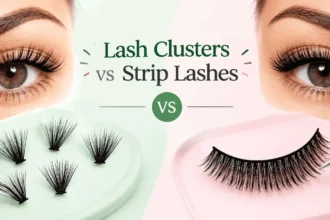


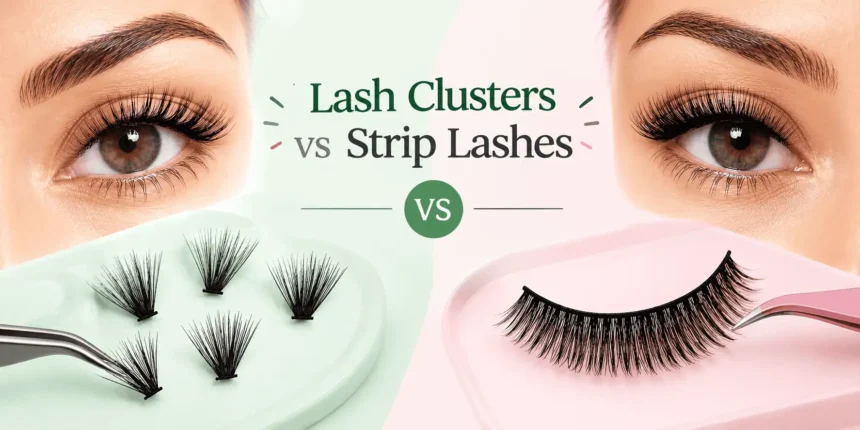
Lash clusters or strip lashes? People ask to want to know often, and honestly, there’s no single right answer, it depends on how much time you’ve got and the look you’re after.
Here’s the difference in a nutshell. Clusters are individual strands you place right under your natural lash line, one by one, which means you get to build a custom lash map. Strip lashes? One band, one shot, instant full-on drama.
Sounds simple enough. But the real comparison goes a lot deeper than that. Placement, wear time, cost, what matter is the finished look. So does how option stacks up against salon extensions. We’re walking through all of it below, so you can figure out what actually works for your eyes and your daily routine.
Lash Clusters vs Strip Lashes: Understanding Key Differences
Picking between cluster lashes and strip lashes isn’t a small decision—it quietly shapes your whole beauty routine, and the lashes look you end up with. Here’s how they actually differ.
Cluster lashes come as segmented lash clusters, and you apply them under your natural lashes lash line with a premium lash adhesive. The result is a customizable lashes setup and a natural customizable effect.
Strip lashes? Those are pre-made strips on a lash band, could be an ultra-thin lash band, a thin lash band, or, if you like more structure, a thicker lash band. You stick them along the lash line with strip lash glue or a strip-specific adhesive.
Here’s the biggest split between them. Strip lashes sit on top of your natural lashes, pressed against the eyelid right at the lash line classic lash line placement. Lash clusters tuck under your natural lashes instead, so the band hides and what you get reads more like an eyelash extension effect than a strip of false lashes. One difference in under lash placement, and everything downstream changes: feel, wear time, how natural they look.
Customization is where clusters pull ahead. A strip comes pre-styled—whatever curl and density the maker settled on is what you get. Clusters let you build a custom lash map: shorter pieces at the inner corner, longer ones toward the outer edge.
That’s lash-by-lash customization at its best. Which is exactly why people hunt down a wispy lash map for almond eyes, or something softer for hooded eyes. Brands like TAD Beauty, Dark Swan of Denmark, Til Next Time (also known for Til Next Time remover), and the Lavish Faux Mink Collection (their Lavish Faux Mink Lashes, plus a Soft Silk Collection with soft silk lashes and silk lashes) all sell into this DIY lashes space.
Their trays usually mix lengths, length lashes, volume lashes, hybrid lashes—so you can build a tailored look on your own. These are the customizable lashes enthusiasts keep coming back to, and plenty of them also carry Secret Cluster Lashes for a discreet finish.
Lash wear time and price tell the rest of the story:
- Strip lashes: one-day wear (temporary lashes). Peel them off at night, reuse them a handful of times if you’re careful. Cheaper cost per pair lashes upfront—but you’re re-gluing every single wear. That’s strip lashes application for you.
- Lash clusters: multi-day wear lashes (Extended Wear Lashes), sometimes up to a week with a premium lash adhesive. Higher cost per set, lower cost per day if they hold. Cluster lashes application eats more time upfront, but it pays off.
- Individual lashes: the old-school middle ground. Applied lashes one by one with individual lash glue. More time than clusters, less flexible than a full custom lash map. Individual lashes application at its most tedious—though some people find it meditative self-care.
And then there’s lash extensions (eyelash extensions), the salon route. You lie down, a 3D lash tech glues delicate synthetic fibers (synthetic fibers, sometimes mink lashes or faux mink lashes, and increasingly 3D printed lashes thanks to 3D printing) onto each natural lash over a couple of hours, and you leave with weeks of wear.
Clusters are basically the at-home lash extensions answer to that, minus the price tag and the appointment. Strip lashes aren’t competing with extensions at all. They’re the quick fix, the five-minute option, the one you grab when you’ve got somewhere to be and no time to fuss—perfect for special occasions.
So which wins? Depends on your patience and your calendar. If you want bold dramatic lashes for one night, a strip is hard to beat—the ultimate glam look. If you want natural glam lashes (feather-light lashes that give fuller lashes without weight) that survive a few days of real life, clusters give you more control. Neither is “better” in some absolute sense, and honestly, most people end up owning both.
Also read: 20 Sustainable Fashion Tips for a Greener Wardrobe
For those ready to level up, intermediate advanced lashes techniques and DIY lash tutorials (many based in the USA and United States) can help you master diy lash application.
And yes, the debate rages on: lashes vs strip, strip lashes vs individual, strip lashes vs individual lashes, individual lashes vs strip, individual vs strip, individual lashes vs strip lashes—no matter how you phrase it, the lash application time, cluster lashes look, individual lashes look, and strip lashes look all factor in.
Some even joke about stripment lashes (a playful mashup of strip and pigment) or Stripment Lashes as a niche trend. At the end of the day, lashes application is personal, and the right choice depends on your eye shape and lifestyle.
Eyelash Extension Market Statistics
Eyelash Extension Market Statistics
Market Size & Growth: Market Value (USD Billion)
Market Size & Growth: Compound Annual Growth Rate (CAGR %)
Industry Professional Statistics: Lash Artist Earnings & Experience
Lash extensions aren’t a fad. The numbers behind the Eyelash Extension Market Statistics show an industry that keeps climbing, and the next decade looks even better. What you’ll find below covers global and U.S. market values, growth rates, and what artists themselves are actually earning.
And here’s why it matters: as lash maps get more personalized, techniques like a lash map for hooded eyes help pinpoint the best lash style for each client, which feeds straight into the broader beauty routine lashes conversation and pushes demand for services from brands like Stripment Lashes and TAD Beauty.
Start with market size, because that’s where the story is clearest. In 2023 the global market sat somewhere between $1.1 billion and $1.7 billion. By 2032? Projections put it at $2.0 billion to $3.0 billion. That’s roughly a doubling in under a decade, and it tells you consumer appetite for lash enhancement isn’t slowing down.
The U.S. tells a similar tale on its own: $1.36 billion in 2020, climbing to a projected $2.31 billion by 2028. Beauty trends and social media deserve a lot of the credit there.
Brands like Dark Swan of Denmark, Til Next Time, and Lavish Faux Mink Collection are picking up real traction, and newer tricks such as 3D printing and segmented clusters are making DIY lashes and Extended Wear Lashes genuinely viable for consumers across the USA and the United States.
- Compound Annual Growth Rate: The global lash extension market runs a CAGR of 6.95%. The wider nails and lash extension treatment market? 5.5%. So, lash extensions are outpacing the category they sit inside. That gap says something, clients are choosing lashes over other beauty services, likely because awareness is up, techniques have improved, and products simply last longer now. Tools like lash maps, plus lines such as Soft Silk Collection and Secret Cluster Lashes, make it easier for pros to personalize and move faster.
- Lash Artist Earnings & Experience: Around 75% of lash artists earn up to $45,000 annually. Not bad for a field with low barriers to entry, though it does cap out for a lot of people. On the experience side, only 25% of lash artists have 5+ years in the chair. That’s a young workforce, high turnover, plenty of newcomers. If you want to stand out, specializing helps. Being a 3D lash tech or mastering DIY lashes techniques separates you from the pack.
Put it all together and you’re looking at an industry with rising valuations, solid growth rates, and a workforce that welcomes beginners while still leaving room for veterans to build loyal clients and bigger paychecks. The Eyelash Extension Market Statistics don’t promise a gold rush. But they do point to steady, durable demand.
What Are Lash Clusters?
Lash clusters are a type of false lashes consisting of multiple lash strands bound together at the base, designed to be applied to the eyelid along the lash line using a lash adhesive. You’ll also see them called segmented lash clusters or individual lashes. What makes them different from traditional lash extensions? They attach to the eyelid instead of one-by-one to each natural lash, which means you get a customizable, enhanced lash look without the salon commitment.
The construction is what sets them apart. Each cluster holds a small fan of strands, usually somewhere between two and ten, fused onto a short base. That base is what you dip into adhesive before placing it. Materials vary quite a bit: faux mink lashes give a fluffy, textured finish, while soft silk lashes have a smoother, more polished sheen. Cheaper sets often rely on delicate synthetic fibers. They work fine, but they can feel stiffer against the lid.
Also read: Why Bamboo Pajamas are Making Waves in the Fashion Industry
Brands like TAD Beauty, Dark Swan of Denmark, and the Lavish Faux Mink Collection built their followings on this format. Secret Cluster Lashes pushed the idea further with lighter bases and finer strands, and the Soft Silk Collection offers a smoother, more polished alternative. What you’re really buying is control. A strip lash is one rigid band with a fixed shape. These come in separate pieces, so you decide where the volume goes.
That’s the whole appeal of at-home lash extensions, honestly. You get the eyelash extension effect, a fuller lash line, a soft wispy finish or something heavier, without booking a 3D lash tech or committing to weeks of aftercare. Think of it as DIY lashes with an escape hatch. Many lash enthusiasts across the USA are embracing this method for its flexibility and cost savings.
How Cluster Lashes Are Applied Under the Natural Lash Line
Applying cluster lashes involves a precise under lash placement technique, where each cluster is attached beneath the natural lashes along the lash line using a specialized lash adhesive. The clusters go under, not over. That single detail changes how the whole set looks and feels.
Here’s the general flow:
- Clean your natural lashes and let them dry completely.
- Curl them gently, then comb through with a spoolie.
- Plan your custom lash map before you open any adhesive.
- Dip the cluster base lightly into premium lash adhesive.
- Place it under the natural lashes, close to the lash line, and hold for a few seconds.
Compared with strip lashes application, there’s no thick band pressing against your lid, and no strip lash glue smeared across the skin. Individual lashes application, where you attach one strand to one natural lash, takes far longer. Cluster lashes sit in the middle: faster than lash-by-lash work, tidier than a strip.
Tools matter more than people expect. A curved applicator or fine tweezers from a TAD Beauty or Til Next Time style kit makes placement much easier, especially for the inner and outer corners where your lashes curve sharply. Expect your first few attempts to be clumsy. That’s normal. Once you’ve done it a handful of times, a full set takes maybe ten minutes.
Why Cluster Lashes Allow for a Customizable Lash Map
One of the biggest advantages of cluster lashes is their ability to create a fully customizable lash map, allowing you to tailor the look to your eye shape and desired effect. Almond eyes or hooded eyes, it doesn’t matter. You can design a placement plan that works with your features instead of fighting them.
For lash map for almond eyes, a common approach is a wispy lash map with slightly longer clusters through the center. It opens the eye and gives that wide, doe-like look. For a lash map for hooded eyes, most people lean toward more volume and length at the outer corners, which lifts a lid that tends to swallow the lash line. Both are easy to build once you understand the logic.
This is where strip lashes fall short. A strip comes pre-styled. You can trim it, sure, but you can’t really redistribute the weight. Cluster lashes let you mix lengths, volumes, and curl patterns across the lash line, a few shorter pieces near the inner corner, three or four longer ones toward the tail. That’s how you land anywhere from natural glam lashes to bold dramatic lashes with the same box of product.
Dark Swan of Denmark and similar brands sell clusters in graded trays for exactly this reason. It’s the difference between wearing a look and building one.
How Long Do Lash Clusters Last?
The longevity of lash clusters depends on the type of lash adhesive used and your aftercare routine, but generally, they can last from a few days to over a week with proper application. The adhesive is doing most of the work here. A temporary formula gives you one-day wear. A premium lash adhesive formulated for Extended Wear Lashes can hold for seven to ten days. In the United States, lash wearers often report similar results based on their daily habits.
Multi-day wear lashes aren’t a marketing trick, by the way. The bond sits under the natural lashes, so it’s protected from rubbing and most daily contact. Still, a few things shorten lash wear time:
- Oil-based cleansers and makeup removers, which break down adhesive
- Heavy sweating or long steam sessions
- Sleeping face-down on the lashes
- Rubbing your eyes out of habit
Everyday humidity and your own oil production play a role too. Some people get a full week easily. Others see lifting by day three or four. Neither is unusual.
When it’s time to take them off, don’t pull. Soak a cotton pad with a gentle remover like Til Next Time remover, press it along the lash line for a bit, and let the clusters slide free. Yanking them off is how people lose natural lashes. Treat the removal step as seriously as the application, and you’ll get months of use out of a single tray.
What Are Strip Lashes?
Stripment Lashes are a type of false lashes made up of multiple lash strands attached to a flexible lash band. You apply them along the lash line with a strip-specific adhesive. They’re the oldest style of temporary lash out there, and people love them for two reasons: they’re easy to use, and the effect is dramatic right away.
Construction matters more than most people realize. The strands might be delicate synthetic fibers, faux mink lashes, or soft silk lashes, and each material changes how the lash looks and feels. A Lavish Faux Mink Collection pair tends to have that fluttery, wispy quality. Silk lashes sit somewhere in the middle. Synthetic fibers usually give you the crispest, darkest line. Advances in 3D printing are even beginning to influence how some synthetic lash fibers are designed for added realism.
Then there’s the lash band, which is really the backbone of the whole thing. An ultra-thin lash band almost disappears against your natural lashes and feels light. A thin lash band is the middle ground most people reach for. Thicker lash bands hold a bolder shape and support heavier volume, though they can feel stiffer on the lid.
Here’s the tradeoff: strip lashes go on as a single unit, so strip lashes application is quick and straightforward. But that convenience comes at a price. They’re built for one-day wear, and they aren’t nearly as customizable as cluster lashes or individual lashes, where you place strands one by one to build a custom lash map.
Also read: A Brief Description of Bracelets History
How Strip Lashes Are Applied Along the Lash Band
Applying strip lashes involves measuring the lash band against your natural lash line, trimming if necessary, and then applying a thin layer of strip lash glue along the lash band. Once the adhesive becomes tacky, you place the strip lashes as close to your natural lash line as possible, pressing gently to secure.
Wait for that tackiness. This is where beginners rush and regret it. Wet glue slides around, and you’ll end up with a crooked strip and glue smudged across your eyelid. Give it thirty to sixty seconds, then set the band down in the center first, then press the inner and outer corners.
Notice the placement difference here. Cluster lashes application often uses under lash placement, tucking segments beneath your natural lashes. Strip lashes sit on top of the lash line instead. That’s why a thin lash band matters so much, it’s the difference between a seamless blend and a visible ridge.
A good strip-specific adhesive makes or breaks the whole look. Cheap glue dries brittle and pops off by lunch. A premium lash adhesive holds through a long day and still lifts cleanly at night, whether you’re using a standard remover or something gentle like Til Next Time remover. For DIY lashes fans, strip lashes give you an instant glam look without mapping a single lash.
Who Gets the Best Results From Strip Lashes?
Strip lashes are ideal for beginners, those who want a quick and dramatic effect for special occasions, and anyone who prefers a temporary, one-day wear option. If you have a steady hand and want an instant glam look without the time-consuming process of applying individual lashes or lash clusters, strip lashes are a great choice.
They also suit people who don’t want to commit to multi-day wear lashes or at-home lash extensions. Weddings, birthdays, a night out. Slap them on, look fantastic, peel them off. No appointments, no touch-ups, no learning curve that eats your whole evening. And the cost per pair is usually the lowest of any option, which matters if you only wear lashes a few times a year.
Eye shape changes things, though. If you have very round or hooded eyes, you’ll likely need to trim the lash band so it doesn’t poke or lift at the corners. A lash map for hooded eyes might push you toward a shorter, flared strip, while a lash map for almond eyes can handle longer, more dramatic styles with ease.
But if a natural customizable effect is what you’re after, cluster lashes or individual lashes will serve you better. You build those strand by strand, so the result looks like your own lashes, just fuller. Strip lashes can’t match that. For a fast, affordable, and impactful strip lashes look, though, they’re hard to beat, and brands from drugstore labels to premium faux mink lashes keep them within everyone’s reach.
Cluster Lashes vs Strip Lashes: Placement and Final Look
Lash clusters and strip lashes don’t sit in the same spot, and that single difference shapes everything about how they look. Clusters go under your natural lash line, which gives you a seamless, natural effect you can customize. Strip lashes sit on top of the lash line, glued along the lash band, and the result tends to be more dramatic and uniform.
Where the lashes sit changes everything, honestly. Cluster lashes go on beneath your natural lashes, one segment at a time, close to the lash line. Strip lashes rest on top, glued along a strip lash band that runs the full width of your eye. That one difference drives the whole look. For a bold, dramatic effect, strip lashes are often the go-to, while for a subtle, natural look, DIY lashes like clusters are preferred.
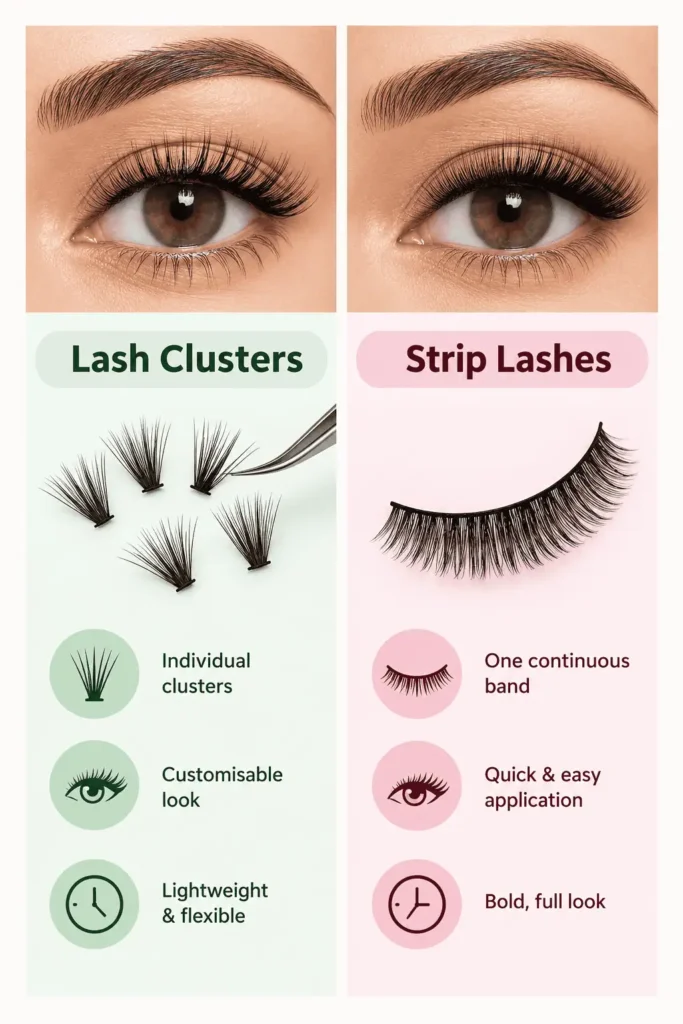
Because of their under lash placement, cluster lashes blend with your own lashes and can mimic the look of lash extensions. You can build a custom lash map for a wispy lash map or go fuller for a volume lashes effect. Strip lashes, by contrast, hand you one fixed shape. Trim the band, glue it down, done. Great for a fast glam look, less great for subtlety.
So which look is right for you? If you want that natural glam lashes finish, clusters are usually the answer. If you need a bold dramatic effect in five minutes, strip lashes get the job done. The comparison comes down to placement and the look you’re chasing.
Which Style Looks More Natural?
For a natural look, lash clusters generally win. Their under lash placement lets them blend with your natural lashes, creating a natural customizable effect that’s hard to pull off with strip lashes.
Since cluster lashes sit beneath the lash line, there’s no visible lash band. Nothing pinches or pokes. That alone makes them far less detectable. You can also tailor the lash map to your eye shape, whether that’s almond eyes or hooded eyes, using delicate synthetic fibers, faux mink lashes, or soft silk lashes for a feather-light feel.
A brand like TAD Beauty leans into this with collections built for DIY lash application, including their Lavish Faux Mink Collection and Soft Silk Collection. Those materials are what give cluster lashes their natural, wispy finish. Strip lashes, even with an ultra-thin lash band, can still look artificial because the band sits on top of the lash line.
That said, a wispy strip lash with a carefully trimmed, thin lash band can pass as natural. Fair enough. But for the most natural glam lashes day to day, cluster lashes are the go-to among DIY lash fans.
Which Delivers a More Dramatic Effect?
If you want a bold dramatic effect, strip lashes usually hit harder right away. They’re built as one unit, with dense, uniform lashes that read as dramatic and glam. In the United States, strip lashes are a staple for quick glam, while in other regions, DIY lashes like clusters are gaining popularity.
Want lashes that stop traffic? Strip lashes have you covered. You’ll find them in extreme lengths and volumes, which is why they show up so often for special occasions, performances, and photography. The Lavish Faux Mink Collection and Dark Swan of Denmark both cater to that high-impact, glam look.
Lash clusters can go bold too, but it takes work. You’d layer multiple segments to build volume lashes and length lashes, maybe reach for a thicker lash band, and accept a longer lash application time. The result is usually more of an eyelash extension effect than full-on drama.
Here’s the honest take: if drama is the goal, strip lashes win. And if you want subtle, buildable, at-home lash extensions, clusters take the crown. Pick based on the look you actually want on your face, then go build it.
Application Time and Ease: Individual Lashes vs Strip Lashes
Strip lashes win on speed. Hands down. A beginner can get a pair on in 5-10 minutes, sometimes less. Individual lashes and lash clusters? They give you way more control over the final look, but that control costs you. Plan on 20 minutes at the low end, and over an hour if you’re chasing serious fullness or you’re still figuring out your technique.
Strip lashes application is about as basic as it gets: run strip lash glue along the lash band, then press the band onto your lash line. Sounds simple, right? Usually it is. But unsteady hands or a strongly curved lash line can turn it into a fight. Band thickness matters too.
A thin lash band flexes against the lid without much fuss, while a thicker lash band holds its shape better but tends to pop loose at the inner and outer corners unless you press firmly.
For anyone just starting out with DIY lashes, though, a strip pair is still the least fussy option on the shelf. And if drama is what you’re after, Stripment Lashes carry a range of dramatic styles.
Cluster lashes application and individual lashes application work nothing alike. You place each cluster or lash one at a time with individual lash glue or a premium lash adhesive, usually following a lash map. Lash by lash, it takes longer. No question. But that’s what buys you the natural customizable effect, lashes that blend in with your natural lashes instead of sitting on top of them as one solid piece.
So for DIY lashes fans, it really comes down to time and skill. Strip lashes stay beginner-friendly and are perfect for a quick night out. Cluster lashes suit intermediate advanced lashes users who want fuller lashes, a wispy lash map driven look, or that at-home lash extensions vibe. Brands like TAD Beauty, Til Next Time, and Secret Cluster Lashes have made the cluster route far more approachable, so the learning curve isn’t as steep as it used to be.
Do You Need a Lash Map for Cluster Lashes?
Yes, using a lash map is highly recommended for cluster lashes to achieve a balanced and tailored look that complements your eye shape. A lash map serves as a blueprint for where to place each cluster, ensuring symmetry and a natural customizable effect. Think of it as a plan before you start gluing, not an afterthought once half your lash line is already covered.
Eye shape changes everything here. Almond eyes love a wispy lash map with longer clusters in the center, since that opens up the eye. Hooded eyes do better with a lash map that stacks volume at the outer corners for a lifting effect. Same clusters, completely different result. That’s exactly why you map it out first.
Skip the lash map and you risk an uneven, unnatural result. Which stings when you’ve just spent twenty minutes placing clusters one by one. Creating a custom lash map is part of the fun of DIY lashes, letting you experiment with different lengths and volumes until you land on your best lash style.
Beginners, start simple. A basic lash map first, more complex designs later, once your hands get steadier. Strip lashes don’t need any of this since the whole lash line comes pre-assembled on one band. But for cluster lashes, a lash map is what separates a polished, tailored look from a lopsided one. Brands like TAD Beauty and Dark Swan of Denmark have leaned into this with map styles built around specific eye shapes, which takes some of the guesswork out of it.
How Much Lash Adhesive Does Each Type Require?
The amount of lash adhesive required varies by lash type: strip lashes need a thin line of strip lash glue along the lash band, while individual lashes and lash clusters require a small dot of individual lash glue or premium lash adhesive at the base of each cluster or lash.
For strip lashes, a little goes a long way. Overdo the adhesive and you’ll get slipping, smudging, and that annoying gooey line across your lid. Underdo it and the corners lift halfway through the night. A thin, even coat along the band is the sweet spot, and letting it get tacky for about thirty seconds before pressing it down makes a real difference.
Cluster work is more fiddly. You’ll dip the base of each cluster into a small amount of adhesive, using just enough to secure it to the natural lashes. This precise application is key to a clean under lash placement, where clusters sit beneath the lashes rather than on the lid.
Premium lash adhesives, like those from Extended Wear Lashes, are formulated for multi-day wear lashes and may need a slightly different technique, sometimes a brush-on application instead of a dip. Some 3D lash tech innovations have even led to 3D printing of custom lash clusters for a perfect fit.
Here’s the counterintuitive part: cluster lashes and individual lashes use less adhesive per application than strip lashes, but the total amount depends on how many clusters you use. A full set might use more than one strip application, spread across dozens of tiny dots.
Proper adhesive usage keeps the hold comfortable and long-lasting, whether you’re going for natural glam lashes or bold dramatic lashes. And if you’re using a remover like Til Next Time Remover between sets, clean lashes take adhesive better next time around.
How Long Do Lash Clusters and Strip Lashes Stay On?
Not all lashes are built for the same lifespan. Strip lashes? One day, 8-12 hours if you’re lucky. Lash clusters hang on quite a bit longer—anywhere from 3 to 10 days, depending on your adhesive and how well you treat them. That difference matters a lot more than people think, especially when you’re choosing a lash style for a wedding weekend versus a random Tuesday.
Multi-day wear lashes, like the ones from Extended Wear Lashes, use a premium lash adhesive that survives showers and sleep for up to a week or more. Stripment Lashes work differently—they rely on strip lash glue, which just isn’t made for overnight wear. And really, you shouldn’t sleep in them anyway. Leave a strip lash on overnight and you’ll usually wake up to a curled-up mess dangling off your lash line. Not worth it.
What cuts wear time short? Oil production, mostly. Humidity plays a part, too, as does how often you wash your face and what products end up near your eyes. Someone with oily lids might squeeze three days out of a set of clusters. A drier-skinned person can coast to seven. It’s personal, and there’s no fixed rule.
If you’re in the United States and want the convenience of longer wear, clusters win. But removing them properly—with something like Til Next Time remover—is what keeps your natural lashes intact for the next round. Let’s break down daily vs multi-day wear, then get into removal and aftercare.
Daily Wear vs Multi-Day Wear
Daily wear is Stripment Lashes territory. You glue them along the lash line in the morning, wear them for the evening, peel them off before bed, done. Simple. And honestly, that on-and-off flexibility is the whole appeal for a lot of people, a temporary lashes option for special occasions or a night out.
Multi-day wear belongs to lash clusters, which stay put for several days to over a week and basically function like at-home lash extensions. These extended wear lashes suit anyone who wants to simplify their beauty routine lashes and skip the daily application. Apply once with a premium lash adhesive and you’re set through workdays, gym sessions, and everything in between.
Both approaches have a place. Stripment Lashes let you swap looks on a whim—a wispy lash map for almond eyes on Friday, something bolder for Saturday. Clusters give you consistency without the fuss. Neither is “better” in some absolute sense, but if your mornings are chaos, clusters will change your routine.
One trade-off worth noting: multi-day wear means less variety. You’re committing to one look for days at a stretch. If you like changing your lash style with your outfit, daily wear might suit you better. It comes down to lifestyle, not skill.
Removal and Aftercare for Each Type
Removal and aftercare look different for each type. Strip lashes come off by gently peeling from the outer corner. Lash clusters need a gentle remover like Til Next Time remover to dissolve the lash adhesive without yanking your natural lashes. Ripping clusters off dry is the fastest way to lose your own lashes. Don’t do it.
Stripment Lashes get a second life. After removal, clean the lash band to strip away old glue so you can reuse the pair. A little patience here saves money over time. Lash clusters, by contrast, are typically spent after one wear cycle—but the natural lashes underneath deserve attention, so cleanse them gently and keep oil-based products away from the eye area.
Why avoid oil-based removers around clusters? They break down adhesive fast, which sounds fine until it shortens your wear time mid-week. A dedicated remover like Til Next Time does the job cleanly and lets the bond release the way it’s supposed to. Brands in this space, including TAD Beauty and Dark Swan of Denmark, build their products around that gentle-release idea. For those in the USA, these brands are readily available.
After removal, give your natural lashes a rest. Condition them, skip the mascara for a day, and let them breathe before your next DIY lashes application. If you’re in the United States, look for brands like TAD Beauty and Dark Swan of Denmark. Whether you’re team strip lashes or team lash clusters, a careful removal routine is what keeps your natural lashes healthy and ready for whatever look you’re building next.
Cost Comparison: Lash Clusters, Strip Lashes, and Lash Extensions
Let’s talk money. Stripment Lashes win on price upfront, you’re looking at $1 to $10 for drugstore pairs, and up to $30 if you spring for premium faux mink lashes. Lash clusters land in the middle at roughly $15 to $40 per set.
Sounds pricier, right? Not so fast.
Clusters are multi-day wear lashes, so your cost per wear often drops below what you’d spend on strips. Then you’ve got lash extensions, the luxury tier: $100 to $300 per session, plus maintenance every 2-3 weeks.
Here’s the thing about cost per wear, though. A $6 pair of temporary lashes you toss after one night works out to real money if you’re wearing them three times a week. Divide that $30 cluster set across a week or more of multi-day wear lashes, and the math flips fast. That’s before you even factor in touch-ups. For example, the Lavish Faux Mink Collection or Soft Silk Collection from TAD Beauty might cost more upfront but save you money over time.
For DIY lashes enthusiasts, lash clusters offer a cost-effective alternative to salon lash extensions, especially when using at-home lash extensions kits. Brands like TAD Beauty and Dark Swan of Denmark sit at different price points, and their Lavish Faux Mink Collection or Soft Silk Collection typically costs more than a basic synthetic set.
Quality shows in the delicate synthetic fibers, and premium lash adhesive adds to the upfront spend but holds extended wear lashes longer, which saves money down the line. Thanks to advancements in 3D printing, some lashes now have even more realistic texture.
So what does a realistic yearly spend look like? Rough numbers help here.
| Option | Upfront Cost | Cost Per Wear | Wear Time |
|---|---|---|---|
| Strip lashes | $1 to $30 per pair | Highest, worn once | One night to a few wears |
| Lash clusters | $15 to $40 per set | Lower, spread over days | Multi-day wear lashes |
| Lash extensions | $100 to $300 per session | High with upkeep | 2-3 weeks plus fills |
Stripment Lashes win for occasional use. A wedding, a night out, Halloween. You grab an affordable pair, slap on some strip lash glue, and you’re done. But if lashes are part of your regular beauty routine lashes, buying pairs over and over gets old, both for your wallet and your patience.
Clusters sit in the sweet spot for most people. Secret Cluster Lashes and similar segmented lash clusters let you build a custom lash map, reuse supplies, and skip the salon chair entirely. At-home lash extensions that use cluster lashes application techniques don’t match the eyelash extension effect of a pro, but they get close enough for everyday wear. And the savings? Substantial. For those in the USA, these are a great option.
Then there’s lash extensions. Nobody argues they look incredible. The fuller lashes, the tailored look from a custom lash map, the way they handle a lash map for almond eyes or a lash map for hooded eyes without you lifting a finger. But the price per session is just the start. Fills every two to three weeks add up, and one wrong rub or a bad reaction means starting over. It’s a commitment, and honestly, not one that fits every budget.
The verdict depends on how you wear lashes. Occasional use? Stripment Lashes, no question. Regular wear on a budget? Lash clusters give you the natural customizable effect without the salon bill. Want flawless without the effort, and you don’t mind paying for it? Lash extensions deliver. Match the option to your habits, not the other way around.
Are Lash Clusters a Good Alternative to Salon Lash Extensions?
Yes. For anyone who wants that eyelash extension effect without dropping a fortune or losing half a day at the salon, lash clusters are a solid alternative. Segmented lash clusters from brands like TAD Beauty, Dark Swan of Denmark, and Secret Cluster Lashes let you build a custom lash map right at home. You apply them under the lash line with a premium lash adhesive, and the finished look mimics individual lash extensions pretty closely.
Salon extensions mean booking a professional 3D lash tech and sitting there for hours. Clusters take 20-30 minutes, and they last for multiple days. Plenty of DIY lashes enthusiasts in the USA have already made the switch.
You get a natural customizable effect, and the cost per pair lashes is dramatically lower than salon services. The tradeoffs? Clusters won’t last as long as professional extensions, and they do take some skill to apply. But for DIY lashes enthusiasts, they deliver a salon-quality look without the salon price tag.
Here’s the thing about cost that most people don’t think through. A full set of salon extensions runs you well over a hundred dollars every few weeks for fills. A single tray of cluster lashes, though? That tray can cover weeks of wear.
Brands like TAD Beauty and Dark Swan of Denmark sell segmented lash clusters in mixed-length trays, so you’re building a custom lash map from one box instead of paying per appointment. Toss in a decent premium lash adhesive and a Til Next Time remover, and your whole kit costs less than one salon visit. For DIY lashes enthusiasts, this is a game-changer.
Time matters too. Salon appointments eat two to three hours, plus the drive there and back. Cluster lashes application takes maybe 20 to 30 minutes once you’ve practiced a few times. That’s your evening back.
Wear time is where the two part ways a little. Salon lashes stick around for weeks. Lash clusters are multi-day wear lashes, so you’re looking at a handful of days before a refresh, more if you sleep carefully and skip oil-based products near your eyes. Some people reapply every morning in five minutes, which is honestly not a big deal once it’s part of your beauty routine.
Skill required is the real dividing line. A 3D lash tech trains for months to place individual lashes one by one without wrecking your natural lashes. Cluster lashes don’t demand that. You still need a steady hand and patience for under lash placement, but a few DIY lashes tutorials and you’re set. This is where intermediate advanced lashes territory begins, not expert.
One tradeoff worth naming: clusters sit under the lash line, which some folks find fiddly at first. If your hands shake, start with a wispy lash map and a couple of shorter segments before trying a bold dramatic lashes look.
- Cost: Clusters win by a wide margin, especially the cost per pair lashes math.
- Application time: 20-30 minutes at home versus 2-3 hours in a chair.
- Wear time: Salon extensions last weeks; multi-day wear lashes last several days.
- Skill: Extensions need a professional. Clusters just need practice.
- Customization: A custom lash map with clusters lets you tweak length, curl, and volume per eye shape.
Materials matter for that natural customizable effect. Faux mink lashes like the Lavish Faux Mink Collection give a fuller lashes look without heaviness. Soft Silk Collection options bend with your natural lashes instead of fighting them. Both come in delicate synthetic fibers that taper like the real thing, which is why the eyelash extension effect holds up in daylight. For extended wear lashes, these materials also help maintain the shape over multiple uses.
So do clusters fully replace salon extensions? Not for everyone. If you want six weeks of worry-free wear and zero morning effort, keep your lash tech on speed dial. But if you want control, lower spend, and a custom lash map tuned to your eye shape, clusters are a legitimate at-home lash extensions answer. Match the segment lengths to your eye shape, keep your adhesive fresh, and the lash clusters look stays close to the salon version.
Also read: 4 Designer Luxury Handbags
Which Is Right for You: Lash Clusters or Strip Lashes?
So which one’s actually right for you? It depends on a few things — your preferences, how you live, and the look you’re chasing. Want something natural you can customize, wear for days, and build into your own lash map? Clusters win. They’re great for DIY lash fans who don’t mind a little extra time up front to get a salon-quality look at home.
Need a fast, dramatic effect for a special occasion instead? Strip lashes. One-day wear, more beginner-friendly, and cheaper upfront. Consider your eye shape, how long you’re willing to spend applying, and your budget.
Here’s the thing about skill level. Strip lashes application takes maybe two minutes once you’ve practiced a few times, and the payoff is instant. Cluster lashes application asks more of you. You’re placing segmented lash clusters one by one along your lash line, which can take twenty minutes or longer when you’re new to it. That’s the real trade-off nobody warns you about.
Want the best of both worlds? Plenty of people do exactly that — strip lashes for events, lash clusters for everyday. Brands like TAD Beauty, Dark Swan of Denmark, Secret Cluster Lashes, and Stripment Lashes offer high-quality options for both. Whichever you choose, always use a gentle remover like Til Next Time to protect your natural lashes.
Once you’ve weighed the options, the choice usually becomes obvious. A few questions can help you sort it out fast.
- How much time do you have? Strip lashes go on in minutes. Cluster lashes take longer, especially while you’re learning.
- How often will you wear them? Daily wear leans toward clusters. Occasional nights out lean toward strips.
- What look are you after? A wispy lash map or a bold, fuller look is easier to build with clusters than with a pre-made strip.
Budget matters more than people admit, too. Strip lashes can cost just a few dollars per pair, while cluster lashes or individual lashes and their lash adhesive usually run higher upfront. But clusters last multiple wears, so the cost per pair lashes can even out over time.
Eye shape plays a role as well. A lash map for almond eyes might place longer clusters at the outer corner, while a lash map for hooded eyes often calls for a shorter, more lifted style. Strip lashes come pre-shaped, so you get less control unless you trim them yourself.
With clusters, you decide every detail, which is why so many people treat them as at-home lash extensions without the salon price. In the United States, this DIY approach has become especially popular for achieving a customized look. Even 3D printing is now being explored for creating precise lash maps and custom lash trays.
Honestly, there’s no wrong answer here. Experiment with both. Try a dramatic strip for a wedding, then test a natural glam set of clusters for a normal Tuesday. You’ll learn your own preferences faster than any comparison guide can tell you. And when you’re ready to remover either one, a product like Til Next Time remover keeps your natural lashes safe instead of yanking them out.
The best lash style is the one you’ll actually reach for. So pick a starting point, keep your beauty routine lashes simple, and adjust from there.