


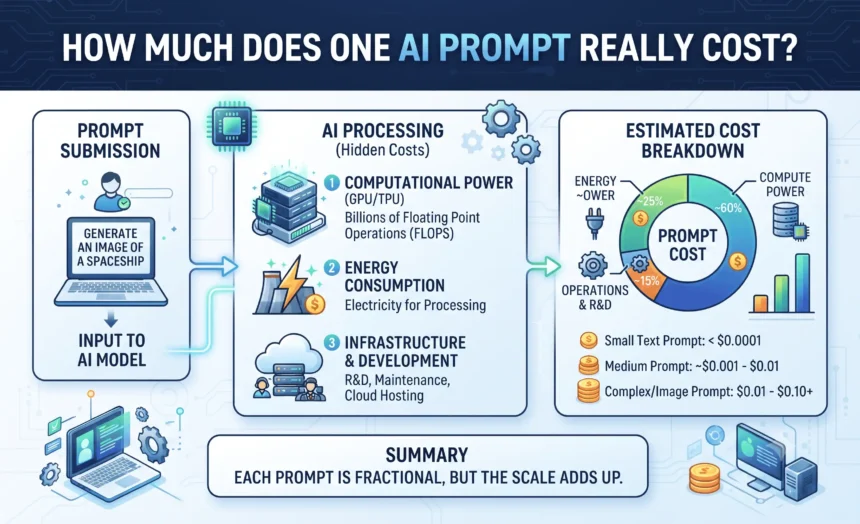
Artificial intelligence has moved from being a futuristic concept to an everyday tool. People now use AI to write emails, research topics, analyze documents, create images, write code, summarize information, solve problems, and even assist with business decisions. But behind every seemingly one AI prompt and response is a physical system consuming electricity and using computer hardware.
That raises an increasingly important question:
How much does one AI actually cost — not just financially, but in electricity, computing resources, water, hardware, and environmental impact?
The answer isn’t as simple as putting a price on one ChatGPT prompt. Different AI models and tasks can require dramatically different amounts of computing power. A short text question is very different from analyzing a large document, performing complex reasoning, generating an image, or creating a video.
At the same time, individual prompts are only part of the story. The bigger environmental question concerns the enormous data-center infrastructure required to train and operate AI systems at global scale. Let’s look at how it works, what it costs, and what it could mean for the environment.
How Does ChatGPT Actually Work?
When you type a question into ChatGPT, it may appear that your message simply travels to a website and an answer comes back.
In reality, your request is sent to computing infrastructure in a data center.
Modern generative AI systems use machine-learning models trained on very large datasets. During training, the model learns statistical relationships and patterns that allow it to generate
useful responses.
When you submit a prompt, the trained model performs inference — using those learned parameters to process your request and generate an output.
A simplified version looks like this:
Your prompt → AI service → GPU/AI accelerator → computation → generated output → your device
The computation involves enormous numbers of mathematical operations. Specialized processors such as GPUs and other AI accelerators are designed to perform these operations efficiently.
The complexity of the task matters.
A short question may require relatively little computation. A long reasoning problem, document analysis, image generation, or video-generation request can require considerably more.
Why Does AI Need So Much Computing Power?
AI models can contain huge numbers of parameters. These parameters are numerical values that help the model represent patterns learned during training.
Training a powerful model can involve processing enormous quantities of data repeatedly.
But training isn’t the only source of computational demand.
Once a model is available, every user request requires inference.
This creates two major categories of computing:
- Training: Building and improving the AI model.
- Inference: Running the trained model to answer user requests.
Training can involve enormous computing workloads over extended periods.
Inference happens every time people use the system. And because millions of people can use AI simultaneously, even a relatively small amount of computation per request can become significant at global scale.
How Much Electricity Does One AI Prompt Use?
There is no single number that applies to every AI prompt.
Energy consumption depends on the model, hardware, input length, output length, reasoning requirements, data-center efficiency, and the type of task.
OpenAI’s public educational material cites independent analysis from Epoch AI estimating that a typical ChatGPT query using GPT-4o consumes around 0.3 watt-hours (Wh). (OpenAI Academy)
That provides a useful reference point, but it should not be treated as a universal measurement for every current AI model or every prompt.
- A simple text request might be relatively efficient.
- A lengthy reasoning task could require much more.
And image and video generation can require substantially more computation.
AI Energy Use: A Simple Comparison
| Activity | Approximate energy | Important note |
|---|---|---|
| Typical AI text query | ~0.3 Wh* | Illustrative estimate; varies by model |
| 10 similar AI queries | ~3 Wh* | Small individually |
| 1,000 similar AI queries | ~0.3 kWh* | Scale begins to matter |
| AI-generated image | Often higher than basic text* | Depends heavily on model and resolution |
| Long reasoning task | Potentially several times higher* | More computation can be required |
| AI video generation | Potentially much higher | One of the more compute-intensive AI uses |
*These are approximate or illustrative figures, not universal measurements. Energy consumption changes with model architecture, hardware, workload, output length, resolution, and data-center efficiency.
The important takeaway is simple:
Not all AI prompts cost the same amount of energy.
What Does One AI Prompt Cost in Electricity?
Suppose we use 0.3 Wh as an illustrative figure for a typical text request.
That’s: 0.0003 kWh
If electricity costs $0.10 per kWh, the electricity component would be approximately: $0.00003
That’s a tiny amount.
However, this calculation should not be confused with the total cost of operating an AI service.
Electricity is only one component.
A company also has to pay for:
- GPUs and AI accelerators
- Servers
- Networking
- Data centers
- Cooling
- Storage
- Hardware depreciation
- Maintenance
- Security
- Engineering
- Model development
- Software infrastructure
Therefore:
Electricity cost ≠ total AI operating cost.
The actual internal cost of processing an individual request is not publicly disclosed in a precise, universal way.
Why Some AI Requests Cost Much More
Consider these two requests:
Request A:
What is the capital of Canada?
Request B:
Analyze this 100-page document, compare it with another document, identify contradictions, perform detailed reasoning, and produce a 5,000-word report.
Clearly, these aren’t equivalent workloads.
The second request can require substantially more computation.
The same applies to creative AI.
Generating a short piece of text is different from producing a high-resolution image.
Generating one image is different from producing a detailed video.
The general progression is:
Simple text → long-context analysis → complex reasoning → image generation → video generation
This isn’t a strict ranking for every model, but it illustrates why AI energy consumption cannot be represented by one universal “energy per prompt” number.
What About AI Image Generation?
AI image generation deserves special attention because it has become extremely popular.
When you ask an AI system to create an image, the system has to perform a large number of computations to transform your instructions into a visual result.
The exact process depends on the model and architecture, but image generation generally requires considerably more computation than a very short text response.
And there is another factor users don’t always consider:
Regeneration
Suppose you ask for an image and generate:
- First version
- Second version
- Third version
- Fourth version
- Ten alternative compositions
- Five different styles
- Three different sizes
You haven’t generated “one image.”
You’ve created many separate computational workloads.
That doesn’t mean users should avoid AI image generation. It simply means that thoughtful prompting can reduce unnecessary computation.
What Happens When You Regenerate an AI Image?
A useful habit is to spend a little more time constructing the prompt before repeatedly clicking
Generate or Regenerate.
For example, specify:
- Aspect ratio
- Image dimensions
- Subject
- Composition
- Style
- Amount of text
- Desired visual hierarchy
- Safe margins
- Important elements that must be included
A clearer prompt can increase the probability of getting a useful result earlier.
The environmental principle is straightforward:
Better planning can mean fewer unnecessary generations.
For professional content production, this can also save time.
AI Training vs AI Inference
Another important distinction is between training and using an AI model.
Training
Training is the process of developing the model.
Large amounts of data are processed repeatedly while the model’s parameters are adjusted.
This can require enormous computing resources.
Inference
Inference happens after the model has been trained.
Every time you ask the model a question, the system performs inference to generate the answer.
A useful way to visualize it is:
Training → Trained model → Millions/billions of inference requests
Therefore, looking only at the electricity used by individual prompts doesn’t capture the complete environmental footprint of AI.
The broader lifecycle includes model development, training, deployment, inference, hardware manufacturing, and infrastructure.
The Hidden Cost: Data Centers
This is where the environmental discussion becomes much more important.
AI systems operate primarily within data centers containing servers, networking equipment, storage systems, power infrastructure, and cooling equipment.
The International Energy Agency estimates that data centers consumed approximately 415 terawatt-hours (TWh) of electricity globally in 2024, equivalent to around 1.5% of global electricity consumption,
The IEA’s base case projects data-center electricity consumption could reach approximately 945
TWh by 2030.
AI is an important driver of that growth.
The issue isn’t simply that computers are becoming more powerful.
It’s that increasingly powerful AI applications are being used by increasingly large numbers of people.
Why Local Impact Can Matter More Than Global Percentages
Global percentages can sometimes make the issue sound smaller than it feels locally.
A data center may represent a relatively small percentage of global electricity consumption.
But data centers are geographically concentrated.
A large facility can place substantial demand on a particular electricity grid.
The IEA notes that AI-focused data centers can reach power levels comparable to energy-intensive industrial facilities, while being concentrated in specific locations.
That can create challenges involving:
- Grid capacity
- New transmission infrastructure
- Electricity generation
- Local water resources
- Land use
- Noise
- Construction
- Community infrastructure
Therefore, the environmental discussion needs to consider both global consumption and local effects.
AI’s Water Footprint
Electricity isn’t the only resource involved.
Water can also be part of the AI infrastructure equation.
Some data centers use water-based cooling systems to remove heat generated by servers.
Water can also be indirectly associated with electricity generation.
However, one of the biggest mistakes in discussions about AI is presenting one fixed number such as:
“Every AI question uses exactly X milliliters of water.”
That’s misleading.
Water consumption depends on:
- Data-center design
- Cooling technology
- Location
- Climate
- Season
- Electricity source
- Hardware
- Operating conditions
- Whether direct and indirect water use are included
A data center in a cool climate using a particular cooling system can have a very different water footprint from another facility operating in a hot or water-stressed region.
So the better conclusion is:
AI infrastructure has a water footprint, but the amount varies significantly by location and technology.
What About Carbon Emissions?
The environmental impact also depends heavily on the electricity source.
Imagine two AI data centers performing exactly the same computation.
One is powered largely by low-carbon electricity.
The other relies heavily on fossil-fuel generation.
Their operational carbon footprints can be very different.
This is why simply asking:
“How much energy does AI use?”
isn’t enough.
We also need to ask:
“Where does that energy come from?”
The IEA estimates that data centers currently use a mix of electricity sources, including renewables, natural gas, coal and nuclear power, with the mix varying significantly by region.
Cleaner electricity can therefore reduce the emissions associated with the same amount of computing.
Does AI Use More Energy Than a Google Search?
This is one of the most frequently asked questions — and it deserves a cautious answer.
Traditional web search and generative AI perform different types of computing.
A conventional search system can retrieve and rank information from a pre-built index.
Generative AI performs model inference to construct a new response.
Older estimates frequently claimed that AI queries use many times more energy than conventional searches. But comparisons are difficult because both technologies have evolved rapidly, and estimates depend on what parts of the computing ecosystem are included.
Search engines themselves increasingly use AI.
Therefore, instead of focusing on a simplistic:
“AI = X times Google search”
it’s better to recognize that generative AI generally introduces additional computation, while the exact difference depends on the model and task.
What About AI Video?
Video is potentially a much bigger issue.
Generating a paragraph involves producing text tokens.
Generating an image involves creating a visual representation.
Generating video means producing many frames while maintaining consistency in subjects, movement, lighting and other elements.
That can require substantially more computation.
The IEA’s 2026 analysis specifically highlights video generation, reasoning and agentic AI as increasingly energy-intensive workloads. It notes that some of these tasks can consume hundreds or even thousands of times more energy per query than simple text generation, depending on the workload and technology.
This is an important reason why simply estimating AI’s environmental impact from an average text prompt can be misleading.
Is AI Bad for the Environment?
The honest answer is:
AI has an environmental cost, but that doesn’t automatically make AI environmentally bad overall.
AI requires:
- Electricity
- Hardware
- Water in some cooling systems
- Data centers
- Raw materials
- Construction
- Networking infrastructure
Those impacts are real.
But AI can also potentially help reduce resource consumption elsewhere.
For example, AI could help:
- Optimize electrical grids
- Improve industrial processes
- Reduce equipment downtime
- Improve building energy efficiency
- Optimize transportation
- Improve agricultural resource use
- Accelerate scientific research
- Assist climate modeling
- Develop more efficient materials
- Predict equipment failures
The International Energy Agency also highlights AI’s potential to improve energy-system operations and efficiency while recognizing its growing electricity demand.
So the real question isn’t simply:
“Is AI good or bad for the environment?”
A better question is:
“Does the value created by an AI application justify the resources required to produce it?”
How Much Does One Person’s AI Usage Matter?
Let’s return to the individual user.
Suppose someone makes 10 ordinary text requests per day.
Using our illustrative 0.3 Wh estimate:
10 × 0.3 Wh = 3 Wh per day
Over a year:
3 × 365 = approximately 1.1 kWh
That is a relatively small amount of electricity.
But if the same person frequently performs intensive reasoning tasks, analyzes very large documents, generates hundreds of images, or creates video, their footprint could be considerably higher.
The key point is:
Individual use matters, but scale matters much more.
The Real Question Is Scale
Consider one billion simple AI interactions.
Using an illustrative 0.3 Wh per interaction:
1 billion × 0.3 Wh = 300,000 kWh
That’s:
300 MWh
And that is only a simplified example.
The real AI ecosystem includes:
- Training
- Text inference
- Long-context processing
- Reasoning
- Agents
- Image generation
- Video generation
- Search
- Data storage
- Networking
The IEA’s latest analysis says global data-center electricity consumption increased 17% in 2025, while electricity use by AI-focused data centers increased even faster. At the same time, energy use per AI task is declining rapidly as hardware and software become more efficient.
This creates an interesting tension:
AI becomes more efficient → but people use much more AI.
Efficiency gains can therefore be partly offset by rising demand.
Can AI Become More Environmentally Efficient?
Yes — and this may be one of the most important parts of the story.
More Efficient Models
Developers can create models capable of producing useful results with less computation.
Better AI Hardware
New processors can perform more calculations per unit of electricity.
Smarter Software
Optimization can reduce unnecessary computation.
Better Data Centers
Improved cooling, power management and server utilization can reduce infrastructure overhead.
Cleaner Electricity
Renewable energy, nuclear power and other lower-carbon sources can reduce emissions associated with computing.
Better Model Selection
Not every task requires the largest or most computationally intensive model.
A simple question shouldn’t necessarily require the same resources as a complex scientific analysis.
The IEA’s 2026 analysis highlights this efficiency trend, while also warning that increasing use of more energy-intensive AI applications can push overall demand higher.
How Can We Use AI More Responsibly?
Users don’t control the design of data centers, but they can make small efficiency improvements.
1. Write Better Prompts
A clear prompt can reduce unnecessary retries.
2. Avoid Unnecessary Regeneration
If the first image or answer is already useful, there’s little reason to generate dozens more versions simply for curiosity.
3. Choose the Right Tool
A simple task doesn’t always need the most powerful model.
4. Reuse Useful Outputs
Save and reuse good results instead of repeatedly recreating them.
5. Be Particularly Thoughtful With Images and Video
Visual generation can require considerably more computation than simple text.
6. Focus on Value
The objective isn’t to eliminate AI usage.
It’s to get meaningful value from the computing resources being consumed.
What Could AI Look Like by 2030?
The next few years could go in several directions.
AI models may become dramatically more capable while becoming significantly more energy-efficient.
At the same time, people may use AI for increasingly demanding applications.
Today’s AI might answer a question or generate an image.
Tomorrow’s AI could continuously analyze data, operate software agents, generate long videos,
control industrial systems, assist scientific research, or interact with physical machines.
That could increase computational demand considerably.
The environmental outcome will therefore depend on several factors moving simultaneously:
AI adoption + model efficiency + hardware efficiency + electricity sources + data-center design
If efficiency improves faster than demand grows, the resource cost of individual tasks could fall substantially.
If demand grows faster than efficiency, total resource consumption could continue rising.
Should We Stop Using AI?
For most people, the answer doesn’t need to be “yes” or “no.”
A more practical approach is:
Use AI when it provides meaningful value, while recognizing that it has a physical resource cost.
This is similar to how we think about other technologies.
Cars consume fuel or electricity.
Smartphones require mined materials and manufacturing.
Cloud storage requires servers and data centers.
Streaming requires networks and computing infrastructure.
AI is another layer of digital infrastructure.
The goal shouldn’t necessarily be zero environmental impact.
The more realistic goal is:
More useful computing with less resource consumption.
The Bottom Line
A single AI text prompt may use surprisingly little electricity.
But that doesn’t mean AI is environmentally free.
The bigger story is the infrastructure behind the technology.
AI requires specialized processors, data centers, cooling, electricity, networking, hardware manufacturing and, in some circumstances, substantial water resources.
And AI’s environmental impact is changing rapidly.
The International Energy Agency expects global data-center electricity consumption to more than double from around 415 TWh in 2024 to about 945 TWh by 2030 in its base case.
At the same time, AI systems are becoming more efficient.
That’s the paradox.
Each individual AI task can become cheaper and more energy-efficient while the world uses dramatically more AI.
The environmental challenge will therefore not be solved simply by making AI smaller, nor by asking people to stop using it.
It will require progress across the entire ecosystem:
more efficient models, better chips, smarter data centers, cleaner electricity, responsible water use, longer-lasting hardware, and thoughtful AI usage.
For individuals, the takeaway is simple.
You don’t need to feel guilty about every question you ask an AI system.
Instead, understand that digital services still have a physical footprint.
Use AI when it creates genuine value. Avoid unnecessary generations and repeated computation.
And when choosing between solutions, consider not only what technology can do, but also what resources it requires.
The most important question may not be:
“How much does AI cost?”
It may be:
“How much useful value can we create from each unit of energy, water, hardware and other resources we consume?”
That question will become increasingly important as artificial intelligence moves from an optional digital tool to a fundamental part of the global economy.