



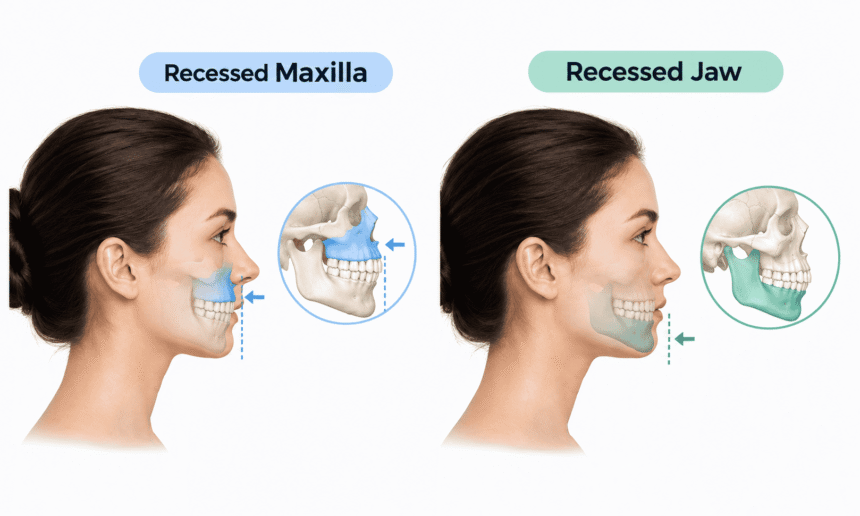
A recessed maxilla and a recessed jaw are not the same thing. The maxilla is the upper jaw. “Recessed jaw” is an everyday phrase that most often points to the lower jaw, but people also use it for a weak chin or a general feeling that the face looks “set back.”
The confusion makes sense. Both jaws shape the profile, and both affect how the teeth meet. This guide explains what each term means, how clinicians tell the problems apart, and what treatment may involve. It is education, not a way to diagnose yourself from a photo. Appearance alone cannot show which bone is involved.
What Is the Maxilla?
The maxilla is the upper jaw bone. It is actually a pair of bones fused at the midline. Together they form:
- The upper dental arch, which holds the upper teeth
- Much of the roof of the mouth
- Part of the floor of each eye socket
- The sides and base of the nose
- The cheekbone area, along with the zygomatic bones
This is why the maxilla shapes the middle third of the face, not just the teeth. Its forward position influences how the nose, upper lip, and cheeks sit in profile.
Maxilla does not simply mean “how the upper jaw looks.” It is a specific bone, and its position is measured against the skull and the lower jaw.
What Is the Mandible?
The mandible is the lower jaw bone. It holds the lower teeth and connects to the skull at the temporomandibular joints, one in front of each ear. It is the only moving bone of the skull, which is why it drives chewing, speaking, and opening the mouth.
The mandible has a horizontal body, a vertical branch (ramus) on each side, and a front portion called the symphysis, where the two halves joined in early life.
The chin is not the same as the mandible. The chin is the bony prominence at the front of the mandible, plus the soft tissue covering it. That distinction matters because a small or receding chin does not automatically mean the whole lower jaw sits too far back.
What Does a Recessed Maxilla Mean?
A recessed maxilla means the upper jaw sits farther back, or has grown less forward, than expected relative to the skull base and the rest of the face. Clinicians call this maxillary retrusion or maxillary deficiency. You may also see midface deficiency or underdeveloped maxilla, especially when the cheek and nasal regions are involved.
Depending on the person, it can influence:
- Midface projection
- The relationship between upper and lower teeth
- The profile around the nose and upper lip
- Bite alignment, including a crossbite or underbite pattern
- Overall facial proportions
Not everyone with a flatter midface has maxillary deficiency. Faces vary widely, and normal variation is common. A diagnosis requires measurement, not impression.
What Does a Recessed Jaw Mean?
“Recessed jaw” is not a clinical term. In most conversations, people mean mandibular retrusion, where the lower jaw sits farther back than expected. Clinicians often use retrognathia for this. Strictly, retrognathia can describe either jaw, but in practice it usually refers to the mandible.
Mandibular retrusion can affect:
- Chin projection
- The lower part of the facial profile
- How the upper and lower teeth meet
- Jaw alignment
Some people also say “recessed jaw” when they mean a recessed chin. Others mean a bite problem. A clinician will ask what the person actually notices before choosing a term.
Recessed Maxilla vs. Recessed Lower Jaw – Key Differences
| Feature | Recessed Maxilla | Recessed Lower Jaw |
|---|---|---|
| Main structure involved | Maxilla (upper jaw) | Mandible (lower jaw) |
| Common clinical term | Maxillary retrusion or deficiency | Mandibular retrusion or retrognathia |
| Facial region | Midface and upper jaw | Lower face and chin |
| Upper teeth | Directly involved, since they sit in the maxilla | May be affected indirectly through bite relationship |
| Lower teeth | May shift to compensate for the bite difference | Directly involved, since they sit in the mandible |
| Typical profile effect | Reduced midface projection in some people | Reduced lower-face and chin projection in some people |
| Possible functional effects | Bite problems, sometimes airway or speech concerns | Bite problems, sometimes jaw-joint or airway concerns |
| Assessment | Clinical exam, bite assessment, cephalometric analysis | Same tools, interpreted differently |
| Treatment | Depends on cause, age, and severity | Depends on cause, age, and severity |
The profile row carries a caution. Two people with the same skeletal pattern can look different, and two people who look similar can have different skeletal patterns. Soft tissue, nose size, lip thickness, and dental position all change the picture.
How Can They Look Different?
Treat this section as general anatomy, not a checklist.
Recessed maxilla. When the midface is reduced in projection, the relationship between the nose, upper lip, cheek area, and upper teeth can change. The lower face may then look relatively prominent, even if the mandible sits in a typical position.
Recessed mandible. Reduced projection of the lower jaw is often linked to a less prominent chin, a more convex profile, and a bigger gap between the upper and lower jaw positions.
Appearance varies enormously. A photo cannot tell you which bone is involved, whether teeth are compensating, or whether anything is clinically significant. Don’t compare your profile to images online to decide where you fit.
Recessed Maxilla vs. Recessed Chin
These terms are frequently swapped, so it helps to separate them.
A recessed maxilla concerns the upper jaw and midface. A recessed chin concerns how far forward the front of the lower face projects.
A person can have:
- A recessed maxilla without significant mandibular retrusion
- Mandibular retrusion with a normal maxillary position
- Both
- A chin that looks recessed for reasons unrelated to overall mandible position, such as chin bone shape or soft tissue
This is why “my chin is small, so my jaw is recessed” is an incomplete conclusion.
How Are These Conditions Diagnosed?
Diagnosis is a clinical process. An orthodontist, oral and maxillofacial surgeon, or dentist may use:
- Medical and dental history
- Facial and profile examination
- Dental and bite examination
- Photographs
- Dental casts or digital scans
- Cephalometric X-rays (a standardized side-view skull X-ray)
- Other imaging, such as 3D scans, when clinically indicated
What cephalometric measurements show
Cephalometric analysis uses points and lines on the side-view X-ray to estimate jaw positions. Three common angles are:
- SNA: the position of the upper jaw relative to the skull base
- SNB: the position of the lower jaw relative to the skull base
- ANB: the difference between the two, which describes how the jaws relate to each other
These numbers help describe a pattern. No single number diagnoses a complex skeletal relationship. Clinicians read them alongside facial growth, dental compensation, soft tissue, and the physical exam. Different analyses also use different reference values, and norms vary across populations.
Dental compensation vs. skeletal position
Teeth can tilt to partly hide a jaw discrepancy. For example, lower front teeth may lean forward to make up for a retruded mandible. The bite can look better than the underlying bone relationship suggests. This is why a dental exam alone cannot answer a skeletal question, and why measuring both matters.
What Problems Can Be Associated With Jaw Position?
Some skeletal jaw relationships contribute to:
- Malocclusion (teeth that do not meet well)
- Difficulty biting or chewing
- Speech concerns in some cases
- Jaw-joint symptoms in some people
- Facial asymmetry
- Breathing or airway concerns in selected patients
None of these follow automatically. Many people have a jaw position that falls outside average and have no functional problems at all. A difference in jaw position is a finding, not a disorder.
Can a Recessed Maxilla or Jaw Affect Breathing?
Sometimes, as one factor among several. Craniofacial structure helps set the size and shape of the upper airway. Jaw position can influence where the tongue sits and how much room exists in the pharyngeal airway behind it.
Still, airway size depends on many things: tonsils and adenoids, nasal obstruction, body weight, muscle tone, tongue size, and age. Obstructive sleep apnea is multifactorial. A recessed jaw does not cause it on its own, and jaw advancement is not a guaranteed cure.
Snoring, pauses in breathing, gasping at night, or heavy daytime sleepiness need a medical evaluation, often with a sleep study. Don’t try to work out airway risk from your profile.
Treatment Options
Treatment depends on age, growth status, severity, the dental and skeletal relationship, symptoms, personal goals, and the underlying cause. Many people need no treatment.
Orthodontic treatment
Braces and aligners move teeth. They can improve many bite relationships. Tooth movement is not the same as changing the position of the jaw bone. In some mild skeletal cases, orthodontists camouflage the discrepancy by positioning teeth to work well together, which improves function without changing the bone.
Growth modification
In children and teens who are still growing, some appliances may influence how the jaws develop relative to each other. Results vary from patient to patient, and skeletal change is not predictable or guaranteed. Timing relative to growth matters.
Orthognathic surgery
Significant skeletal discrepancies may be treated with orthognathic (jaw) surgery, usually planned together by an orthodontist and an oral and maxillofacial surgeon. Surgery can reposition the maxilla, the mandible, or both. It is considered after a full assessment, and appearance alone does not establish a need for it. Risks, recovery, and realistic outcomes belong in a one-on-one discussion with the surgical team.
Chin procedures
Procedures that change chin projection, such as a genioplasty or a chin implant, alter only the chin. They do not reposition the whole mandible or change the bite. They answer a different question from orthognathic surgery.
Can Adults Correct a Recessed Jaw Without Surgery?
It depends on what is actually causing the problem. Adult treatment differs depending on whether the issue is dental, skeletal, soft-tissue related, or a mix.
Orthodontics can move teeth at any age, and that can fix a dental problem or camouflage a mild skeletal one. Once growth is complete, orthodontics does not move adult jaw bones forward the way surgery can. Large skeletal differences may need surgery to correct fully.
Be cautious about claims that exercises, devices, or “jaw-growing” programs reshape an adult jawbone. They lack reliable evidence as skeletal treatments.
Common Misunderstandings
“A recessed chin means my whole jaw is recessed.” Not necessarily. Chin shape and mandibular position are related but separate.
“An overbite always means a recessed lower jaw.” No. An overbite can come from the teeth, the jaws, or both.
“A side-profile photo can diagnose jaw position.” It cannot reliably show a skeletal diagnosis.
“Orthodontics always moves the jaw forward.” Orthodontics mainly moves teeth. Growth modification may affect the jaws in selected growing patients.
“Jaw exercises can reshape the adult jawbone.” Evidence does not support this as a treatment.
When Should Someone See a Professional?
Consider an evaluation if you have:
- Significant bite problems or difficulty chewing
- Jaw pain or limited jaw movement
- Facial asymmetry
- Persistent breathing concerns or sleep-related symptoms
- Questions about how a child’s jaws are developing
An orthodontist or dentist is a reasonable first stop for bite and alignment issues. An oral and maxillofacial surgeon assesses cases that may involve surgery. A physician or sleep specialist handles suspected sleep-disordered breathing. A cosmetic concern alone does not mean you need medical treatment. If it bothers you, a consultation can help you understand your options and decide for yourself.
Frequently Asked Questions
Is a recessed maxilla the same as a recessed jaw?
No. The maxilla is the upper jaw. “Recessed jaw” usually refers to mandibular retrusion, but it is not a precise clinical term.
Is a recessed chin the same as a recessed mandible?
Not necessarily. Chin projection and overall mandibular position are related but distinct.
What is maxillary retrusion?
It means the upper jaw sits relatively far back compared with the skull base and other facial structures.
What is mandibular retrusion?
It means the lower jaw sits relatively far back. Clinicians often call this retrognathia.
Can you have both a recessed maxilla and a recessed mandible?
Yes. Jaw relationships can involve both bones, and they can retrude to different degrees.
Can orthodontics fix a recessed maxilla?
It depends on age and cause. Orthodontics can move teeth and, in some growing patients, influence jaw development. It does not reposition an adult maxilla the way orthognathic surgery can.
Does a recessed jaw always cause an overbite?
No. Bite relationships depend on the positions of both jaws and the teeth.
Can a recessed jaw affect breathing?
It can contribute to airway dimensions in some people, but breathing disorders have many causes and need medical assessment.
How is a recessed maxilla diagnosed?
Through clinical examination, dental and bite assessment, facial analysis, and imaging such as cephalometric X-rays when indicated.
The Takeaway
The difference between a recessed maxilla vs. a recessed jaw comes down to which bone you mean. A recessed maxilla involves the upper jaw and midface. A recessed lower jaw involves the mandible, and “recessed jaw” is a loose phrase that can also mean a recessed chin or a bite problem. Only a clinical assessment, including measurements and a bite exam, can tell them apart.


